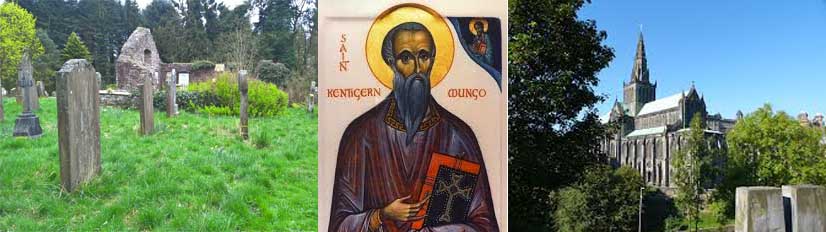
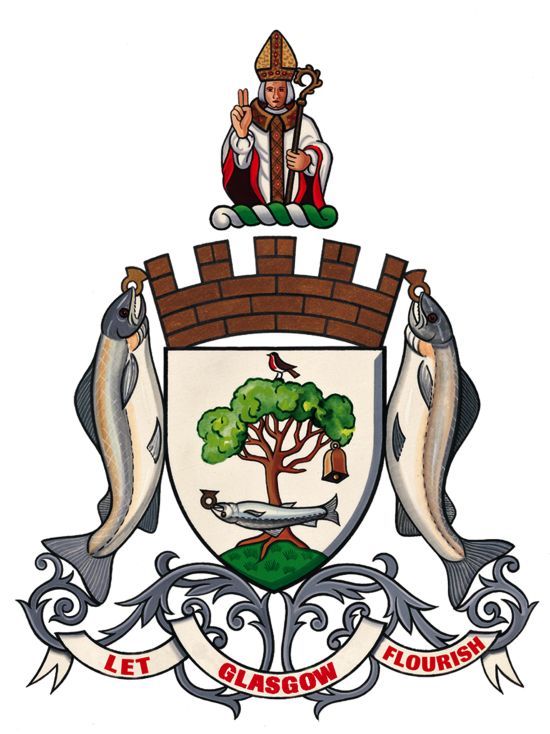
Kentigern, otherwise known as St Mungo, is the patron saint of Glasgow. Much of his life story is based upon a collection of myths and miracles, commemorated in the Glasgow coat of arms – the bird, the bell, the tree and the ring. He was however, a real person who lived in the second half of the 6th century about 150 years after the departure of the Romans from Scotland. He was contemporary with St Columba whom, it is claimed, he met. At that time Strathclyde was part of a North British kingdom which encompassed southern Scotland and Cumbria. It was ruled by powerful princedoms who owed a loose allegiance to tribal kings and it was surrounded on all sides by hostile nations. Constant warfare on the borders and among rival princes would have been the norm. Add to this, the clash between an insurgent Christian evangelism and the established Druidic orthodoxy and it can be surmised that the activities of a Christian missionary would not have been without incident.
From the tangle of legend, myth and scant historical fact we can discern with qualified confidence that Kentigern was well-connected. He was the son of princess Teneu (Enoch) daughter of LLanddeu king of the powerful Goddodin tribe in Lothian. He was born out of wedlock and it is speculated that his father was a Christian king, Owain mab Urien who ruled in Rheged. It was probably this liaison that led to serious upset and Teneu was banished from the Traplain court of her Druidic father. She sought refuge in Culross on the north side of the Forth Estuary where the young Kentigern was brought up in the care of the monks of St Serf. They gave him the nickname Myncho (Mungo) meaning ‘Dear Boy’. The later name of ‘Kentigern’ is a title derived from Kendyern meaning ‘chief lord’, possibly reflecting his increasingly important status. On reaching adulthood he left the monastery in Culross and headed west to establish his monastic cell on the banks of the Molendinar burn where it flows down to the Clyde and where Glasgow Cathedral is now sited.
Possibly as a result of a dispute with the Strathclyde King, Morken, Kentigern was obliged to leave Glasgow for reasons of safety. He journeyed south to seek protection at the court of Owain mab Urien, King of Rhegged, the kingdom which bordered Strathclyde and lay north and south of the Solway Firth. There he continued his evangelical activities and was gifted a piece of land at Hoddom situated on the banks of the Annan just north of the present town of that name. There Kentigern established an episcopal seat which, it is said, grew to rival Lindisfarne in importance. Nothing remains of the buildings today but the site can be seen to have been well chosen, situated in a fertile valley capable of supporting a large community and strategically located for forays north into Strathclyde and south across the Solway. Kentigern spent many years directing his evangelising activities from Hoddom until he was eventually asked to return to Glasgow by King Rydderich Hael. There he resumed his bishopric and presided over an extensive See until his death.
It is recorded that Rydderich Hael sent a large deputation to Hoddom to escort Kentigern back to Glasgow. This pilgrimage trail celebrates Kentigern’s triumphal return by retracing the footsteps of that journey. The exact route, of course, is not recorded but we can indulge in some informed speculation. He would almost certainly have followed the road system left behind by Agricola’s legions which led up Annadale and he would have approached Glasgow along Clyde River pathways. It is also knwon that his evangelising activities had taken him into the upper reaches of Tweedale. The final route chosen for the Kentigern Way is necessarily a compromise of the authentic, the practical and the aesthetic, but we believe that it is substainily authentic.
|