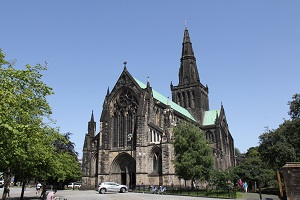
The Cathedral's origins date back to about AD 550 when St Mungo, also known as St Kentigern, founded a religious community here around a small church. Today this original church is the site of the Blacader Aisle in the Lower Church of the cathedral, the structure that extends beyond the very short South Transept.
During Kentigern's time the church was visited by St Columba. After his death on 13 January 614, St Kentigern was buried close to his church. His tomb today lies in the centre of the Lower Choir, probably on the actual site of his grave.
St Kentigern's original church was built of wood, and was probably changed and enlarged over the following five centuries. The first stone church on the site was consecrated in the presence of King David I in 1136 and occupied the area now covered by the nave, with part of the earlier church probably surviving off to one side. This first stone church was destroyed or badly damaged by fire within a very short time, and its replacement was consecrated in 1197 by Bishop Jocelin.
The earliest significant parts of what you can see today are the walls of the nave, up to the level of the bottoms of the windows. These date back to the next round of rebuilding, in the early 1200s. In the mid-1200s much of the rest of the cathedral appeared: in particular the upper and lower choirs were added to the east end of the nave.
In the 1400s a tower was built above the crossing, and two more at the western corners of the nave. At the same time the Blacader Aisle was built on the site of St Mungo's original church and the chapter house was added at the north east corner of the choir.
In the 1800s major repairs included the removal of the two western towers leaving the cathedral much as you see it today.
Today's visitor to Glasgow Cathedral finds an awe inspiring place. It is overlooked from the east by the Glasgow Necropolis and has a fine precinct created by the building in 1993 of the St Mungo Museum, which doubles as a Cathedral Visitor Centre.
The site on which the cathedral was built slopes down from west to east. This allowed the building of its most unique
feature, a lower church effectively occupying the whole of the area under the choir. This is a beautifully vaulted space.
At its heart lies the tomb of St Kentigern or St Mungo, while at its east end are a series of chapels.
These include the Chapel of St John the Evangelist, still containing part of what is believed to be the well, used by
St Kentigern in the late 500s. These chapels were particularly well used after 1451, when the Pope declared that
a pilgrimage to Glasgow Cathedral would carry the same merit as one to Rome. In the same year he approved the
foundation of the University of Glasgow.
|

