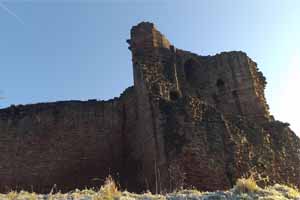
Bothwell is one of the most attractive of the grand Scottish castles. It is in a fabulous location on a bend in the River Clyde where a fairly deep gorge has been cut. The oldest parts of the castle are built of beautiful deep red sandstone and the masonry work is breath-taking.
The castle stands at a strategic location - the main crossing point of the Clyde for any invaders coming from the south. As such it has played a major part in the wars between England and Scotland and both sides gained and lost possession of the castle many times.
The castle was originally built by Walter of Moray or, quite likely, his son William in the thirteenth Century. Many of the finest masons from continental Europe were brought in. The quality of the work of the master masons is still there to see in the beautifully dressed mouldings around windows and doorways and arches in the old tower.
However, work stopped long before the castle was finished. Maybe money ran out. Maybe the wars with Edward I of England got in the way. Most likely both of these were factors.
In 1296 Edward I took the castle. In 1298 the Scots laid siege for over a year before finally retaking it. Edward was back again in 1301 with innovative new siege engines and the castle changed hands once more. The English held on to it until the Battle of Bannockburn in 1314. After the battle a number of the English lords took shelter here, but the constable of the castle surrendered the fortress and it was once more in the hands of the Scots. Twenty-two years later, Edward III invaded from England, captured Bothwell Castle and made it his invasion headquarters. But just a few months later Sir Andrew, a descendant of Walter of Moray, retook the castle. Robert Bruce's policy was to destroy castles that the English could use to control the Scots and Andrew pulled down much of the donjon tower.
The Black Douglass's took possession of the castle when Archibald ‘The Grim’ married Joanna
of Bothwell in 1362. In the late 1300s and early 1400s the Douglass's repaired and extended the buildings and their work forms a substantial part of what stands today.
|

