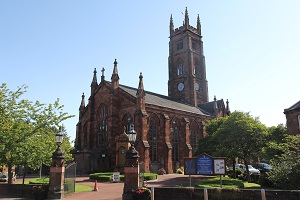
Christianity was introduced to the people inhabiting the fertile valley of the river Clyde at a very early time.
And, probably, one of the earliest settlements was at Bothwell – in the centre of the valley, at the ford of the river and easily accessible from all directions. Some believe it was the site of Druid worship before it became the site of a Christian community.
By the end of the first century, the busy trade route from Carlisle to Dumbarton ran along the hillside to the east and north of Bothwell. Roman legions had encamped close to where the present church stands. As in the days of St Paul, so for long afterwards, Christianity travelled along the Roman roads. Having come from Gaul, it is quite possible that these soldiers were the first to bring news of Christianity to the peasants living along the river Clyde in this part of Scotland.
In 587 AD Columba crossed from Iona to the mainland and travelled south. Meeting with Kentigern (St Mungo)
at what is now Glasgow, Columba encouraged Kentigern to continue evangelising southwards. When Kentigern
began his journey, he arrived at a crossing over the river Clyde around which peasants farmed and fished.
Here Kentigern stayed for some time, building a shrine, no doubt of wattle and turf, and giving locus to
the worship of the fledgling Christian community. Remaining with him was one of Columba's followers, named,
Baithene (Bothan). (Could he, possibly, be the source of the name, Bothwell? )
In the mid-12th Century King David 1 created and granted the Barony of Bothwell to David Olifard. He
built a motte and bailey stronghold near the site of the present church and probably beside the original
religious settlement. In the 13th century the Lordship of Bothwell passed by marriage to Walter de Moravia
(Moray) and he set about constructing a much grander castle to reflect his status. After Bannockburn the
Lordship pf Bothwell passed into the hands of the Douglass family and Archibald Douglas ‘Archibald
the Grim’ had a collegiate church built on the site of the pre-existing church.
The relationship between the church at Bothwell and the cathedral of Glasgow was strengthened following
the death of Archibald, Earl of Douglas (benefactor of the church). So that prayers may be said – as at
Bothwell – for the safety of his soul, and that of his family and successors, his widow pledged to
the cathedral the gift of three stones of wax yearly for the improvement of worship and to supplement the
lighting. This annual gift was made upon the feast of Pentecost. Sadly, after some years, the benevolence
defaulted. It was resurrected in more modern times however when, come Pentecost, the congregation of
Bothwell gifted flowers for the adornment of Kentigern's tomb which lies in the cathedral crypt.
Later improvements to the church added the present Nave and subsequently linked this with the existing
Quire by means of a bell tower to form the fine building which you see today.
|

