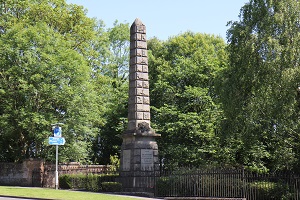
Following the Restoration of Charles II, the Presbyterians in Scotland were obliged to adopt the Episcopalian form of worship and were increasingly persecuted for their beliefs. This broke the terms of the National Covenant and hard-line Covenanters continued their Protestant form of worship at prescribed outdoor meetings, known as conventicles. These were often broken up by squads of government dragoons , including those led by John Graham of Claverhouse On 1 June 1679, Claverhouse had encountered such a gathering at Drumclog, but his troops were routed by armed Covenanters and he was forced to flee to Glasgow. Following this initial success the Covenanters spent the next few weeks building their strength, as did the government. Charles' son, James Duke of Monmouth was sent north to take command, and the militia were raised.
The Covenanters established a camp on the south bank of the Clyde, north of Hamilton. They numbered around 6000 men, but were poorly disciplined and deeply divided by religious disagreements. They had few competent commanders and were riven with internal doctrinal disputess. The government army numbered around 5000 regular troops and militia, and was commanded by Monmouth, supported by Claverhouse and the Earl of Linlithgow. The royalist troops were massed on the northern or Bothwell side of the river Clyde on sloping ground that included a field that has since become known as the Covenanters Field.
The battle centred on the narrow bridge across the Clyde, the passage of which Monmouth was required to force in order to come at the Covenanters. David Hackston led the defence of the bridge for the Covenanters and had some initial success in the initial skirmishes at the bridge itself. But his men were badly supported, lacked artillery and ammunition, and were forced to withdraw. Once Monmouth's men were across the bridge, the Covenanters were quickly routed. Many fled into the parks of nearby Hamilton Palace, seat of Duchess Anne, who was sympathetic to the Presbyterian cause, and it was in this area that the final engagements took place. The numbers of covenanters who were killed varies widely with estimates ranging from 7 - 700 according to the Scottish Battles Gazetteer. Around 1200 were taken prisoner and were taken to Edinburgh where they were held on land beside Greyfriars Kirkyard in an area now known as the Covenanters' Prison.
|

