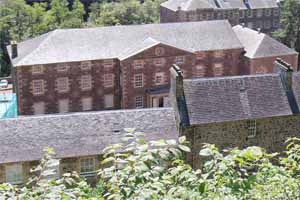
The New Lanark cotton mills were founded in 1786 by David Dale in a partnership with Richard Arkwright. The mills used the recently developed water-powered cotton spinning machinery invented by Arkwright. Dale sold the mills, lands and village in the early 19th century to a partnership that included his son-in-law Robert Owen. Owen, who became mill manager in 1800, was an industrialist who carried on his father-in-law's philanthropic approach to industrial working and who subsequently became an influential social reformer. New Lanark, with its social and welfare programmes, epitomised his Utopian Socialism. The town and mills are important historically through their connection with Owen's ideas, but also because of their role in the developing industrial revolution in the UK.
The New Lanark mills depended upon water power. A dam was constructed on the Clyde above New Lanark and water was drawn off the river to power the mill machinery. The water first travelled through a tunnel, then through an open channel called the lade. It then went to a number of water wheels in each mill building. It was not until 1929 that the last waterwheel was replaced by a water turbine. Water power is still used in New Lanark to provide electricity for the tourist areas of the village.
In Owen's time some 2,500 people lived at New Lanark. Owen found the generally prevailing conditions of work
unsatisfactory and resolved to improve the workers' lot. He paid particular attention to the needs of the 500 or so children
living in the village and working at the mills, and opened the first infants' school in Britain in 1817.
New Lanark became celebrated throughout Europe, with many statesmen, reformers and royalty visiting the mills. They were astonished to find a clean, healthy industrial environment with a content, vibrant workforce and a prosperous, viable business venture all rolled into one. Owen's philosophy was contrary to contemporary thinking, but he was able to demonstrate that it was not necessary for an industrial enterprise to treat its workers badly to be profitable. Owen was able to show visitors the village's excellent housing and amenities, and the accounts showing the profitability of the mills.
As well as the mills' connections with reform, socialism and welfare, they are also representative of the industrial revolution that occurred in Britain in the 18th and 19th centuries and which fundamentally altered the shape of the world. The planning of employment in the mills alongside housing for the workers and services such as a school also makes the settlement iconic in the development of urban planning
After the mills closed there was a large migration away from the village, and the buildings began to deteriorate. The top two floors of Mill Number 1 were removed in 1945 but the building has since been restored and is now the New Lanark Mill Hotel. In 1963 the New Lanark Association (NLA) was formed and restoration of other buildings commenced. In 1974 the New Lanark Trust was founded to prevent demolition of the village.
The site is now controlled by the NLT, either directly or indirectly. Most of the buildings have been restored and the village is now a major international tourist attraction.
|

