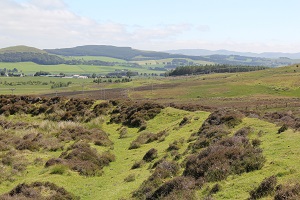
(Path to Tinto Hill from Kentigern Way NS 965 374)
Tinto is an outlying hill of the Southern Uplands comprising little more than this one top standing proud of the main range on the west bank of the River Clyde, some 8 kilometres west of Biggar. The name Tinto possibly derives from the Scottish Gaelic word teinnteach, meaning "fiery", which may refer to its historic importance as a look out beacon. The name may alternatively be attributed to its exposed red hue felsite rock which visible in many places on the hill and which glows a fiery red when a setting sun illuminates the hillside.
At the summit sits "Tinto Cairn" and with a diameter of 45m and a height of 6m it is one of the largest Bronze-Age round Cairns in Scotland.
At the base can be seen the distinct remains of an iron-age fort indicating the strategic importance of Tinto in ancient times.
It has been suggested that Tinto was connected with religious ceremonies associated with its cairn which may date back to the Neolithic era. Some maintain that the festival of Beltane was celebrated here in the Iron Age. The feast of Beltane occurred around the beginning of May and marked the beginning of summer when cattle were driven out to the summer pastures. Rituals were performed to protect the cattle, crops and people, and to encourage growth. Special bonfires were kindled, and their flames, smoke and ashes were deemed to have protective powers. The people and their cattle would walk around or between bonfires, and sometimes leap over the flames or embers.
|

