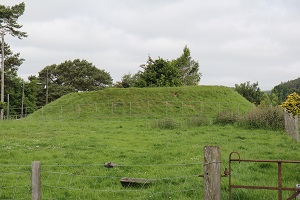
A motte-and-bailey castle is a fortification with a wooden or stone keep situated on a raised earthwork called a motte, accompanied by an enclosed courtyard, or bailey, surrounded by a protective ditch and palisade. Relatively easy to build with unskilled, labour, but still militarily formidable, these castles were built across northern Europe from the 10th century onwards, spreading from Normandy and Anjou in France, into the Holy Roman Empire in the 11th century. The Normans introduced the design into England and Wales following their invasion in 1066. Motte-and-bailey castles were adopted in Scotland, Ireland and the Low Countries in the 12th and 13th centuries.
Coulter Motte was probably raised in the mid-twelth century to control a key area of movement between upper Tweedsdale and Clydesdale. Precisely who built the castle is not known for certain but it could have been a Flemish family, de Cuiter, one of a number of immigrant families encouraged by David I (1124-53) to settle in Scotland and help to bring the unruly country under his control. Other Flemish families settled in the area at this time and are remembered in the local place names such as Roberton, Laminton and Symington.
Little is known about the structure itself. The motte was presumably topped by a timber palisade and surrounded by a ditch. The bailey was situated on the South eastern side. This would have included a settlement with various ancillary buildings; such as a kitchen, stables, Brewhouse and bakehouse.
|

