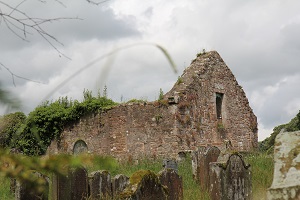
The former parish church of St Mungo comprises the remains of a medieval and later church and graveyard, It
survives as a ruined building with associated memorials and gravemarkers within a stone boundary wall. The church was first
recorded in around 1120 as "Abermelc", one of the possessions of the see of Glasgow.
Only the chancel (E gable), S wall and part of the N of the church are upstanding, in places almost to wallhead
height. Although the church was redeveloped in the 1740s and 1750s, a lower string course survives along the E gable and
this is likely to represent the surviving medieval remains of the building, as are portions of the N and S walls. In around
1880 the Jardine family (converted the church's remains into a family burial plot. The Jardine headstones are mainly
located into the E and S walls of the church.
It provides a good example of a documented later medieval church and graveyard, where the church was later
remodelled and adapted in the 19th century for use as a private family burial plot. The standing remains of the church
display a number of building phases and these indicate a long period of use and re-use.
This church was part of a network of parish churches covering the country and served as a central place for
worship, prayer, baptism and burial. Part of the see of Glasgow, it was therefore part of the wider organisation of
religion in medieval Scotland. It is one of 39 churches known to have held parochial status in eastern Dumfriesshire
before the Reformation and one of only a few local examples that substantially survive.
|

